


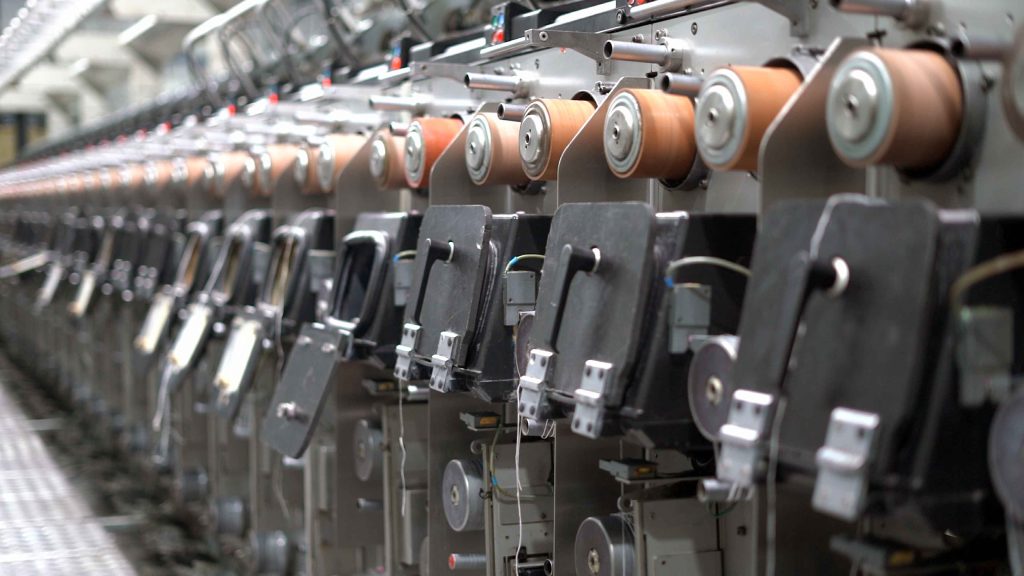
Polyester filament yarns are one of the most important products in the textile industry chain. Due to their features such as high strength, good elasticity, surface uniformity, high dyeability and competitive price, these yarns are used in various types of clothing, home textiles, industrial textiles, carpets, etc. The production of these yarns is carried out using advanced machinery and precise technologies, which are introduced below.
Machines and main stages of polyester filament yarn production
1. Chip Feeding Unit
 Raw materials: Polyester chips (PET), in the form of granules
Machines: Chip dryer, automatic feeding system
Purpose: Reduce the moisture content of the chips to prevent defects in spinning
2. Extrusion and polymer melting (Extrusion Unit)
Machine: Extruder (Single/Double Screw Extruder)
Task: Melt the polyester chips at a controlled temperature (about 280–300°C)
Control: Element temperature, internal pressure, viscosity
3. Melt spinning (Melt Spinning Machine)
Machine: Spinneret
Description: The melt passes through filters and exits through nozzles with micron holes to produce thin filament strands.
Cooling system: Cold air or air-water to solidify the filaments
4. Drawing & Orientation
Machine: Multi-zone Draw Frame
Application: Increase strength, ultimate tensile strength, control filament length
Output of this section:
POY (Partially Oriented Yarn): Partially oriented yarn for texturing
FDY (Fully Drawn Yarn): Fully drawn yarn, end-use
HOY (High Oriented Yarn): High-stretch yarn, special applications
5. Heat Setting
Machine: Oven or Heater Zone
Purpose: Stabilize molecular structure and prevent shrinkage in end-use
6. Twisting & Winding
Machines:
Twisting Machine: To create twist (if needed)
Winding Machine: To collect yarn on industrial bobbins
Feature: Uniformity in spool weight, yarn tension control, speed Top
Quality Control and Final Packaging
Quality control tests include:
Tensile strength test
Denier uniformity
Twist, luster and elasticity testing
Automatic packaging machinery with coding, labeling and bagging
Conclusion
Polyester filament yarn production machinery is the beating heart of modern textile factories. In addition to increasing production capacity, the use of advanced equipment reduces waste, increases yarn uniformity and meets global standards.
